
Coral reefs are MORE RESILIENT than we thought in 2018 not less so - the Global Tipping Points report is by an advocacy group of scientists not evidence driven science

This story is NOT TRUE.
QUOTE [FALSE] Even under the most optimistic future warming scenario — one in which global warming does not exceed 1.5 degrees Celsius above pre-industrial times — all warm-water coral reefs are virtually certain to pass a point of no return [THEY ARE NOT].
https://www.sciencenews.org/article/coral-collapse-climate-tipping-point
You can see it can’t be very plausible by a simple argument. Remember corals have ALREADY warmed up by about 1.2 C since preindustrial. 1.5 C is an extra 0.3 C. How could that lead to them vanishing? They would have to be very close to some hard limit for that to work, and they aren’t.
It is possible for them to vanish but only at well above 3 C and we don’t get there on low emissions. only vanish at well above 3 C.
Corals show surprising unexpected resilience in experiments from 2022
The evidence is rather the other way around that corals are MORE resilient than they seemed to be in 2018 when they thought that 99% would be lost at 2 C (not 1.5 C).
This is a study from 2022 that found surprising resilience for corals
Study lasted for 22 months, most last only days to 5 months
Corals need time to adapt to the warmer conditions
They used the three most common coral species in Hawaii, Montipora capitata, Porites compressa and Porites lobata.
They simulated 2 C warming with the pH reduced -0.2 pH (separately and both together)
61% of corals survived warming, compared to 92% exposed to current ocean temperatures.
survival rates were 71% for P. compressa, 56% for P. lobata and 46% for M. capitata.
The Porites species were especially resilient
Also they may be able to adapt even better in the real world - they rely on zooplankton as a food source when under stress - and the study conditions may not have given them as much as they needed.
“We may have underestimated their capacity for resilience in this study. It may be higher on the reefs,” Grottoli said
. Hawaiian corals show surprising resilience to warming oceans
This isn’t about the corals evolving. Just the same species but with the individual corals given time to adapt to the new temperatures.
Nowhere gets too hot, it is just about the time it takes for them to adapt to even a 1 C rise
There is nowhere in the world too hot for them at those temperatures once they adjust it is just that they are slow at adjusting to even a 1 C rise. Even though the sea temperature varies by several degrees day and night and through the year but they are very vulnerable to a small increase in the maximum temperature.
But some can survive by migrating to cooler conditions - and starting new reefs if necessary. And then for the ones that adapt to warmer conditions, they can stay where they were, ending up covering a larger range than before.
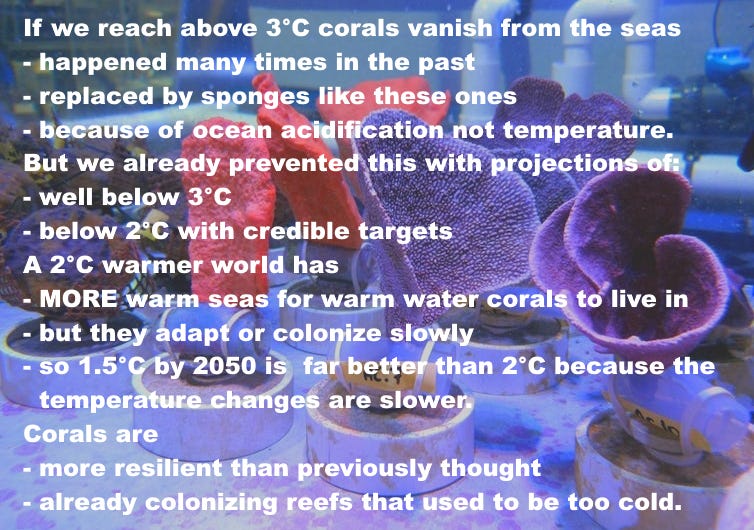
If we reach above 3°C corals vanish from the seas
- happened many times in the past
- replaced by sponges like these ones
- because of ocean acidification not temperature.
But we already prevented this with projections of:
- well below 3°C
- below 2°C with credible targets
A 2°C warmer world has
- MORE warm seas for warm water corals to live in
- but they adapt or colonize slowly
- so 1.5°C by 2050 is far better than 2°C because the temperature changes are slower.
Corals are
- more resilient than previously thought
- already colonizing reefs that used to be too cold.
Here are new corals growing alongside seaweed in temperate waters off southern Japan.
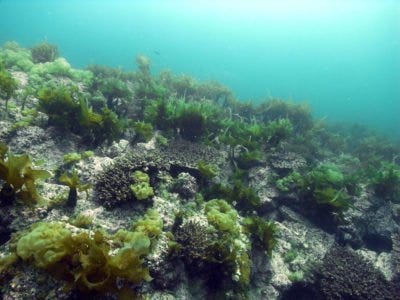
In southern Japan, for example, at 33 degrees north, more than 70 coral species now occupy most of Tatsukushi Bay. In the United States, staghorn and elkhorn corals are extending their ranges northward up the Atlantic coast of Florida. And in Australia, coral appear to be migrating south from the Great Barrier Reef to the coast of New South Wales around Sydney, at 30 degrees south.
This has been going on for a while, but until now nobody had assembled the complete picture. Price’s six-nation study, published last month, finds that with coral on the move, the map of the world’s reef-building tropical coral is being redrawn.
. As Oceans Warm, Tropical Corals Seek Refuge in Cooler Waters
I cover that here:
BLOG: Reason for hope for corals that many more survive at 2 C than previously thought
— much quoted figure of 99% lost at 2 C based on study from 2016
— recent research suggests many corals may be more resilient
You can read it here:
https://debunkingdoomsday.quora.com/Reason-for-hope-for-corals-that-many-more-survive-at-2-C-than-previously-thought-much-quoted-figure-of-99-lost-at-2-C
A warmer world is more habitable overall for many species so long as the transition is slow enough
Slow warming on low emissions actually leads to a more habitable world overall for many species and for ourselves - once we are adapted to it with appropriate buildings / technology / ways of farming etc.
A warmer world is actually more habitable in many ways - even for corals.
If we get there slowly then
1.5 C
1.7 C
even well above 2 C nearly to 3 C is far more habitable for warm water corals once they adjust
BLOG: The warming of the Anthropocene has benefited the world in many ways — the issue is the speed of change and we likely wouldn’t want to go rapidly back to preindustrial from 1.8 C READ HERE: https://debunkingdoomsday.quora.com/The-warming-of-the-anthropocene-has-benefited-the-world-in-many-ways-the-issue-is-the-speed-of-change-and-we-likely-wo
Many things we can do to help corals adapt
Then there are many things we can do to make it easier for corals to adapt.
This for instance is a new discovery
QUOTE STARTS
Researchers found that certain species of rocky pink algae, known as crustose coralline algae (CCA), play a critical role in signaling coral larvae to settle. These algae release metabolites—organic compounds that act as chemical cues—into the surrounding water. Coral larvae detect these cues and are guided to attach to surfaces nearby, where they begin to grow.
… They developed a transparent bio-ink infused with metabolites derived from CCA. This substance, called SNAP-X, gradually releases the same chemical cues into the water over the span of a month.
By applying SNAP-X to underwater surfaces such as rocks or artificial reef structures, the researchers aimed to create an environment that would encourage coral larvae to settle naturally.
To test the effectiveness of their invention, the University of California team conducted outdoor experiments under conditions that closely mimicked the natural ocean environment. Using continuous water flow and real seawater, they observed how coral larvae reacted to surfaces treated with SNAP-X.
The results were striking. The larvae of Montipora capitata, a vital reef-building coral species native to Hawaii, were found to be 20 times more likely to settle on areas coated with SNAP-X compared to untreated surfaces. Moreover, increasing the concentration of metabolites in the ink led to even denser coral settlements.
… The research team is currently working on ways to scale up the production of SNAP-X for larger-scale restoration projects. Because the ink does not contain any living materials, it may be easier to obtain regulatory approval for use in real-world marine environments.
“It’s really exciting,” said Wangpraseurt. “I think a lot of the technologies for restoring and protecting our environment are already there, we just need to look outside the box into other fields of study.”
Then we can rescue them when it gets too warm and then return them:
BLOG: The Coral Reef Restoration Foundation acted swiftly to save corals from their coral nurseries from the marine heat wave, moved them to big marine aquariums on land where they will grow for several months then get returned to the sea
You can read it here:
https://debunkingdoomsday.quora.com/The-Coral-Reef-Restoration-Foundation-acted-swiftly-to-save-corals-from-their-coral-nurseries-from-the-marine-heat-wave
Or help to establish them and help new coral reefs to recover in many ways
BLOG: Hope reef
— word “hope” spelt out on Google Earth as restored coral reef
You can read it here:
https://debunkingdoomsday.quora.com/Hope-reef-word-hope-spelt-out-on-Google-Earth-as-restored-coral-reef
Global tipping points report by an advocacy group associated with the Potsdam institue
So what about the Global Tipping points report? - Agenda- driven rather than rigorous adherence to scientific objectivity
That explains why they don’t highlight these points and how much promise there is to save the corals in all their diversity especially on low emissions.
I’d never heard of the “global tipping points report” - they are not high impact.
Turns out they are associated with the Postdam institute.
The report says: “Reviewed by: Johan Rockström”
Page 45 of here https://global-tipping-points.org/download/1418/
Though they are scientists and often with a decent reputation their work isn’t like the IPCC it’s almost research to an agenda rather than just looking into the facts and following wherever the research goes.
Agenda- driven rather than rigorous adherence to scientific objectivity.
Rockstrom’s planetary boundaries concept has no real world applicability as yet and remains ivory tower research - lots of papers but no way to apply them to anything
Rockstrom is responsible for the planetary boundaries concept which is also very controversial. The issue is that it has no real world applicability. They make up these numbers but have no actionable conclusions or predictiosn from them. So they are not used by the IPCC. It’s occasionally mentioned but never to guide policy - it simply can’t be used for that. At present it is ivory tower research which the authors believe some day may be applicable.
BLOG: Planetary boundaries idea is NOT used by the IPCC and widely criticised
— not even a North American fresh water “boundary”, as it costs too much to pipe water from e.g. MIssissipi (increasing water flow) to Colorado (decreasing flow)
You can read it here:
https://debunkingdoomsday.quora.com/Planetary-boundaries-idea-is-NOT-used-by-the-IPCC-and-widely-criticised-not-even-a-North-American-fresh-water-boundar
First Global Tipping Points report launched at COP28 in 2023 - BUT AS A SIDE EVENT - just like the Green Peace side event - NOT OFFICIAL IN ANY WAY
The first Global Tipping Points report was launched at COP28 in 2023 which sounds impressive.
https://report-2023.global-tipping-points.org/
But no, it was just as a side event.
It was NOT in any way official. Anyone can do a side event at the COPS. For instance Green Peace often do. It does NOT imply any kind of endorsement by UNFCC or the IPCC
Here is the Green peace side event at COP28
Naturally the UNFCC by permitting Green Peace to hold a side event at COP28 did NOT by doing so endorse ANYTHING that Green Peace might say at that event. It is just an expression of freedom of speech.
Just like the Hyde Park authorities in London do not endorse the people who stand up and speak at Speakers Corner.
In the same way the Global Tipping Points Report is NOT endorsed by the UNFCC or by the IPCC and is NOT used to frame policy or referred to in the deliberations of the nations.
It’s an advocacy organization a bit like a scientific version of Green Peace.
Writes lots of papers but they are not written in the same way most papers are. Agenda driven, with the conclusion to some extent mapped out before they start.
I go into some of the background here:
And this is a conversation I had with Perpleity AI, which came up with more cites. This is just a word pattern generator and it can say very dumb things but some of what it says here may be useful, use with caution.
https://www.perplexity.ai/search/who-is-responsible-for-the-glo-K0a0A_l2TcyyepJP54PwVA?1=t